

Running a trucking company often means managing tight margins while dealing with unpredictable payment cycles. You deliver a load today, but the broker or shipper might pay in 30, 60, or even 90 days. In the meantime, fuel needs to be bought, drivers need to be paid, and repairs don’t wait. A freight factoring company solves this cash flow gap for thousands of carriers.
The two most common rate structures are flat factoring rates and tiered factoring rates. Choosing the right one can affect not just your costs but also the variety of loads you can accept and the brokers you can work with. At Apex Capital, we offer both flat and tiered factoring options and customize them around your business. No one-size-fits-all approach. Here’s a transparent breakdown to help you decide what best aligns with your operation.
What Is a Flat Factoring Rate?
A flat factoring rate charges the same percentage fee on every invoice, no matter how quickly (or slowly) the customer pays. Sell a $1,000 invoice at 3.0%, and you receive $970 upfront, for example. The factoring company collects the full amount later; the remainder is determined by the advance rate. Typical flat invoice factoring rates for trucking companies range from 1.5% to 3.5%, influenced by your average invoice size, monthly volume, and the credit quality of your customers.
Key Advantages:
- Predictability, you always know your exact cost per load without surprises or fluctuations.
- Simple budgeting and load quoting, making it easier to plan expenses and price freight with confidence.
Limitations:
- You pay the full rate even on invoices that pay in 10–20 days, reducing your margin on fast-paying customers.
- Many flat-rate programs are more restrictive. Brokers or shippers with slower average payment histories may be declined or require exceptions, potentially limiting the freight you can haul.
Real-world example: A dry van carrier based in Georgia hauls primarily for two consistent shippers that pay reliably in 28–35 days. A 2.85% flat rate gives them rock-solid cost certainty. They can quote loads confidently and maintain steady operations without second-guessing cash flow each week.
What is a Tiered Factoring Rate?
Tiered rates adjust the fee based on the actual days it takes the customer to pay. Faster payments = lower factoring fees. Slower payments = higher fee. A typical tiered structure might look like:
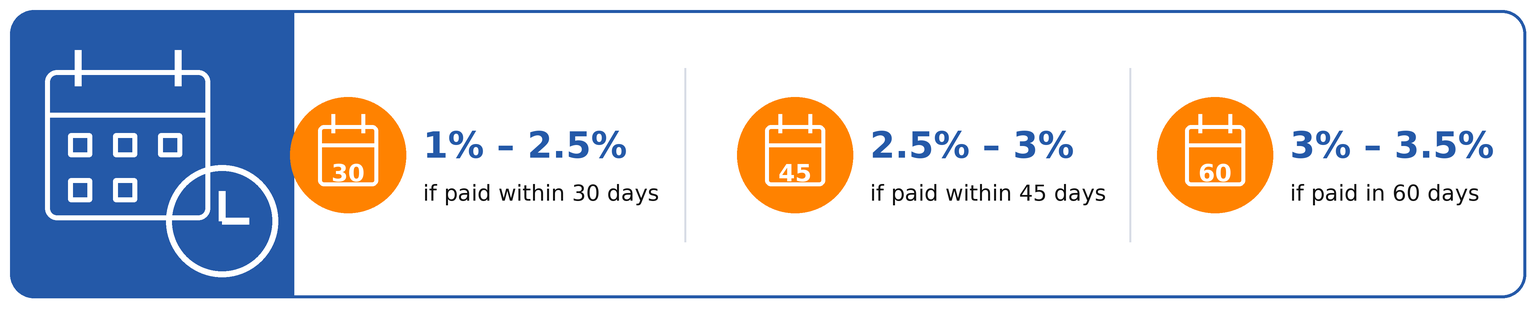
These tiers are typically customized after reviewing your recent customer payment history.
Key Advantages:
- Greater flexibility to factor invoices from a wider mix of brokers and shippers, including those with longer payment terms.
- Potential for a lower factoring cost across your entire client base.
- Supports growth by letting you say “yes” to more opportunities without uniform penalties.
Limitations:
- Monthly costs can vary if your payment mix fluctuates.
- Requires a factoring partner, experienced with diverse customer bases.
Real-world example: A Midwest flatbed and reefer fleet works with a broad mix: strong shippers paying in 18 – 28 days, several brokers on 35 – 50-day terms, and occasional slower government or project loads. Under a tiered program, their fast-paying invoices incur a fee of just 1.8–2.1%. This flexibility allowed them to accept 12–18% more loads per month than a stricter flat-rate provider had previously limited or declined. Their effective blended rate dropped below their old flat rate, while load hauling utilization improved.
$1,000 Invoice Cost Example:
(We’ll use $1,000 to keep the math easy.)
Carriers with 40–60% of invoices paid within 30–35 days frequently see lower total annual factoring costs under tiered structures and the ability to haul more varied freight.
Which Rate Structure Fits Your Trucking Operation?
Flat rates are often a good choice when:
- Your freight comes from a small group of reliable shippers with consistent, relatively fast payment terms.
- You prioritize simple budgeting and avoid month-to-month surprises.
- Your business runs in a stable lane where predictability matters most.
Tiered rates often deliver clear advantages when:
- You maintain a diverse mix of brokers and shippers with varying payment cycles — the reality for many growing carriers.
- You want flexibility to pursue a wider variety of loads without frequent invoice rejections.
- You want to improve cash flow and make more money by keeping your trucks moving.
In today’s freight market, the ability to work comfortably with a broader range of creditworthy brokers can mean the difference between sitting trucks and steady revenue. Many carriers we work with discover that a well-designed tiered program not only maintains strong cash flow but also actively supports business expansion.
Deciding Between Flat vs Tiered Rates
Pull your invoices from the last three to six months. What percentage of those invoices typically pay within 30 days? How many stretch past 45? The answer usually points you toward the better structure for your business.
Why Apex Capital Offers Both Flat and Tiered Rates
Unlike many factoring companies that push a single structure and are selective about slower-paying customers, Apex gives you the choice between a flat rate and a tiered rate. We review your recent customer list, payment patterns, and growth goals, then recommend and customize the structure that best supports your operation.
Some carriers even use a hybrid approach for different segments of their business. This flexibility is backed by transparent pricing with no hidden fees, same-day or next-day funding, substantial fuel card savings through our friends at TCS, unlimited credit checks, and the convenient Apex Mobile Factoring™ app for submitting invoices, managing funding, and documents on the go.
For over 30 years, Apex has been America’s Favorite Factor by providing real options instead of forcing carriers into rigid programs.
Flat vs. Tiered Factoring Rates: Key Questions Answered
Which option gives more flexibility?
Tiered rates typically provide better flexibility for carriers with mixed customer bases.
What are the main differences between flat and tiered factoring rates?
Flat charges the same fee regardless of pay speed. Tiered adjusts the fee based on actual days to payment.
How do broker payment terms affect each structure?
Flat rates can limit options with slower brokers. Tiered rates accommodate varied terms more easily, often resulting in broader access to the load.
How does Apex help match the right structure?
We analyze your specific customer mix and customize terms accordingly — no pressure to fit into a single box.
Ready to Optimize Your Cash Flow?
Apex offers both flat and tiered factoring options and will customize the best solution to fit your unique customer mix. Apply Today for a transparent, no-obligation quote today and see exactly how each option would perform with your real invoices. Or call us at 844-204-6608 – we’re here to help you make the smartest decision for your trucking company.